Sunday, May 27, 2012

Los Otros


The theme of this play is described as being about immigration and I thought, "Oh great". Something that will be about the poor Mexican immigrants from the biased bleeding hearts liberal point of view. But it wasn't. It is about a man and woman (no names, just Man and Woman) who separately tell/sing about their experiences. Their experiences and stories were touched by immigrants.

It started off a bit strange.  A woman in her mid-forties dressed only in a slip, starts her story as a little girl back in 1952 in a small town near San Diego. She and her girlfriends would always go to a train tunnel to watch the trains trundle past. One day, a man and his wife with their baby strapped to her, jump from the slow moving train.  The girls watch from the shadows as the family leave the tracks and find a cave to hide. Claiming the family as theirs, the girls bring sacks of food for them.  This goes on for 3 days until they see a produce truck with people in the bed of the truck. Amongst the huddled people is their family.  Broken hearted, the girls watch the truck drive away.

She tells stories of her life as she gets older, including the time her ex-husband George helps her get a maid in Tijuana. Another story is when she seduces a young field laborer while they were eating at a late night taco stand while she was in a drunken stupor. I didn't enjoy this part, thinking she was going to be hurt or worse.

Then a Hispanic man comes out to sing/tell his story. First he clarified that he is a US citizen, thank you very much. His mother left Mexico after a terrible hurricane leveled her village. He is now a gay, 70 year old accountant. He tells the story of when he was a young boy, his family would drive north every summer to pick plums for a bitter, crippled landowner who is waiting for his son to return from the war in the Pacific during WWII. During that summer, as the war was ending, the Man discovers his sexuality.

In his later years, his partner of 15 years brings his ex-wife into their home.  The Man is okay with the wife coming into their lives.  In fact, she becomes the "wife" for both men. The Man's partner collects art, but it was too much. The Man was going to leave his partner due to "elegant hoarding". But, he doesn't. More years go by and the Man is showing signs of Alzheimer's. His partner of now 30 years is helping him and his ex-wife comes on stage. It is the Woman from the earlier part of the play.  The Man's partner is George, the ex-husband of the Woman.

It was a very different delivery of their stories through singing and talking. But I got into it because the stories were compelling. Max said he liked the Man better than the Woman. He gave the play B-. 

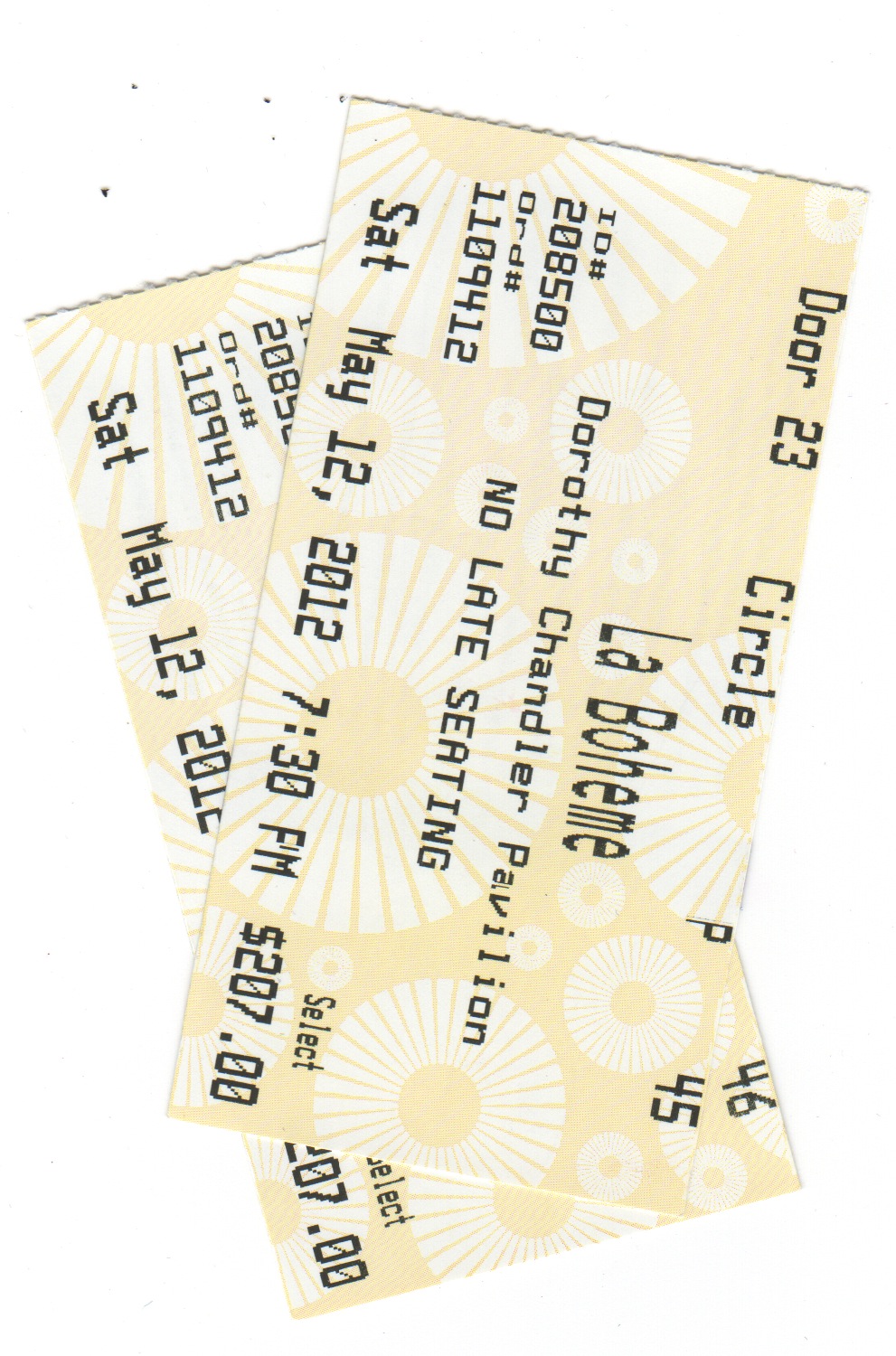
Saturday, May 12, 2012

Opera-La Boheme


Ah, another performance of La Boheme.  We will never tire of Puccini’s famous classic.  Boy meets girl, Boy loses girl, girl dies story line.

Mimi and Rodolfo meet when Mimi, his neighbor, knocks at his door.  Her candle is blown out by the wind and as they look for her dropped key, they fall in love.  The aria at this point is one of the the most beautiful.

In the second act we meet the incomparable Musetta.  I think Musetta is a much more dynamic role and if I were an opera singer, I would rather play her.  Rudolfo, Mimi and their friends go to a cafĂ© to celebrate the holidays. The other part of this act that I love is the townspeople, vendors and toy sellers’ gaiety around them.  It is one of the lighter moments as Musetta and Marcello ignore one another but at the end of the second act, they fall into each other’s arms.


In the 3rd and 4th acts, Mimi’s health is deteriorating.  She wants to break up with Rudolfo because of her health and he is also jealous.  She confides with Marcello and Rudolfo comes onto the scene, overhearing her distress.  They are torn, but they get back together.  At the end of the 4th act, Mimi returns to Rudolfo and passes away quietly.  It is always a tear jerker when Rudolfo discovers Mimi’s death and he wails in grief.  Argh.  It always gets me.

Beautiful and memorable and I know this won’t be our last La Boheme.  This would definitely be one of the plays I would recommend to a first-timer to become oriented with Opera by starting with one of the best. 


Sunday, May 6, 2012

Follies


The staging was a dilapidated theatre.  The staging branched out to the audience as the box seats had drab canvas draped over the sides.  

Our seats were in the front row and it seemed a tight squeeze considering there is a 23 piece orchestra below the stage. Also, our seats were right in the middle, so close that Max could reach out and tap the back of the conductor's head. 

It wasn't what I thought it was going to be. I thought it was going to be about the Follies years ago. In a way it is, but it takes place in the 70's when the Follies girls are in their older years. They return to the last night of the theatre that is going to be demolished to be turned into a parking lot. The older Follies women reminisce as their younger selves dance and sing about them.  There are some regrets and disappointments on how their life's choices turned out. 

Being the old broad that I am, I related to the ladies, but I don't have any regrets.  I love the man and life I chose and he still loves me. 

It was interesting that throughout the show, in the background Follies girls with elaborate gowns and headdresses wandered through the dilapidated theatre as ghosts of the past.  During intermission, they continued to haunt the stage. We could also hear wind blowing through the abandoned theatre. Wonderful costumes and staging. 

I enjoyed it, but Max tolerated it, giving the show a C+, not willing to pay another $200 to see it. 


Sunday, March 18, 2012

Waiting For Godot


This is a classic play by Samuel Beckett, originally written in 1949.  There have been many plays and movies since.  This is described as absurdist play about 2 men, Vladimir and Estragon, who for the entire play is waiting for a man called Godot. 

There is no reason why.  But each day at the same time and same place atop a hill next to a tree, they converse while waiting for Godot.  Most of the play is about the two characters who seem to be down on their luck or even called hobos.  The set is stark.  So why is something so simple and unassuming, be so popular?

There are many interpretations indicating there are political and philosophical meanings behind the simple concept of the play.  I am a simple person and did not get into the possible deep meanings behind their conversation, which at times, made no sense. I was mesmerized because it was so thought provoking.  Without any music, action, sex or silliness, it stood on it’s own because of the dialog. 

I enjoyed it thoroughly and there is actually a Youtube performance to see again and again.   Here is also a summary of the plot on Wikipedia. 

Saturday, March 17, 2012

American Idiot


American Idiot takes the music from the band Green Day and turns it into a musical.  This isn’t the happy go lucky, feel good kind of musical.  It is angry and sad as 3 young men try to figure out their lives in the midst of suburbia. To me, they were spoiled brats who have everything, compared to the rest of the world.  Yet they drown themselves in video games, TV, drugs, and rock and roll.  I didn’t have a connection to their plight. 

One guy turns more to love and drugs but then he discovers his girlfriend gets pregnant and he is resistant to marriage and children.  The second guy joins the military and winds up wounded in the Middle East.  His story was interesting as he is drugged up in the hospital, he hallucinates making love with the nurse.  The bedding, the guy and the nurse are elevated by wires so they are floating above the stage, making love.  The 3rd guy continues his downward spiral with drugs and takes a menial job that he hates.

There is hope at the end of the show as they finally accept their circumstances and begin their growth as adults.  But to me, the music was too loud and angry.  It isn’t quite the rock and roll I grew up with and more hard edged.  But the audience loved it.  The audience was younger and they seemed to be familiar with the songs. 


Saturday, February 11, 2012

Opera-Simon Boccanegra


This is the first time we saw this opera by Verdi.  We are not familiar with the story, but all we knew is that Placido Domingo played the lead role of Simon.  It is such an honor to hear the master sing.  He could be very well sitting back being the Director of the LA Opera and many other opera houses around the world, but he stays on top of his game by performing periodically.

In 1339, Simon is brought into power as the Doge of Genoa who was just a sailor and mercenary.  This is due to the influence of Paolo Algiani who is a power in the leading party.  Simon agrees so that he can be worthy enough to marry his love, Maria.  They already have a daughter Amelia.  But Maria dies and their daughter vanishes.  Maria’s father, Fiesco doesn’t forgive Simon for Maria’s death and the disappearance of his granddaughter.

25 years later, Simon’s daughter Amelia grows up in the Grimaldi family who had been exiled.  Fiesco is her guardian, but doesn’t know who she really is.  I don’t remember how she came to be in the Grimaldi family, but it does sound a bit farfetched that Fiesco doesn’t know who she really is if she has the slightest resemblance to her mother.  But ah, this is an opera. 

Simon pardons the Grimaldi family and promises Amelia to Paolo.  But as he gets to know Amelia and she reminisces about memories as a girl, he realizes who she really is.  He then dismisses the promise of marriage to Paolo so that she can marry her true love, Gabriele Adorno. 

Paolo, seeking vengeance, orders his men to kidnap Amelia, but they fail.  Simon suspects Paolo, so curses the kidnappers and orders Paolo to do the same.  To keep from incriminating himself, Paolo reluctantly curses himself. 

So then Paolo poisons Simon. Paolo is found out and is led away to be executed.  Simon eventually dies, but only after he belts out a dying aria and blesses the marriage of Amelia and Adorno.  He also requests that Adorno succeed him as the Doge. The crowd cheers the new Doge as they respect Simon’s dying wish. 

Beautiful performance by Placido. I don’t remember the others to comment, because Placido was the memorable star.


Sunday, January 15, 2012

Clybourne Park

There were a few empty seats and we haven't heard much about this play, so we weren't quite sure what to expect. Maybe not much. But it turned out to be thoroughly enjoying. It was shocking, funny and a great day at the theatre.

This play is an extension of the play, "A Raisin on the Sun", which coincidentally is playing in Hollywood at the Geffen Theatre. That classic play is about the Younger family in 1959 who saves and struggles to move out of the Chicago Projects. They are able to do so because of the Life insurance check the mother Lena receives when her hard working husband passes away. They put a down payment on a house in Clybourne Park, an all white neighborhood.

Karl, a member of the Clybourne Park neighborhood "welcoming committee" tries to buy them out to avoid having a colored family move in, affecting the quality and value of their neighborhood.  In the "A Raisin in the Sun", the family declines even though they are tempted.  As the hopeful end of the play, the moves to their new life in their new home. 

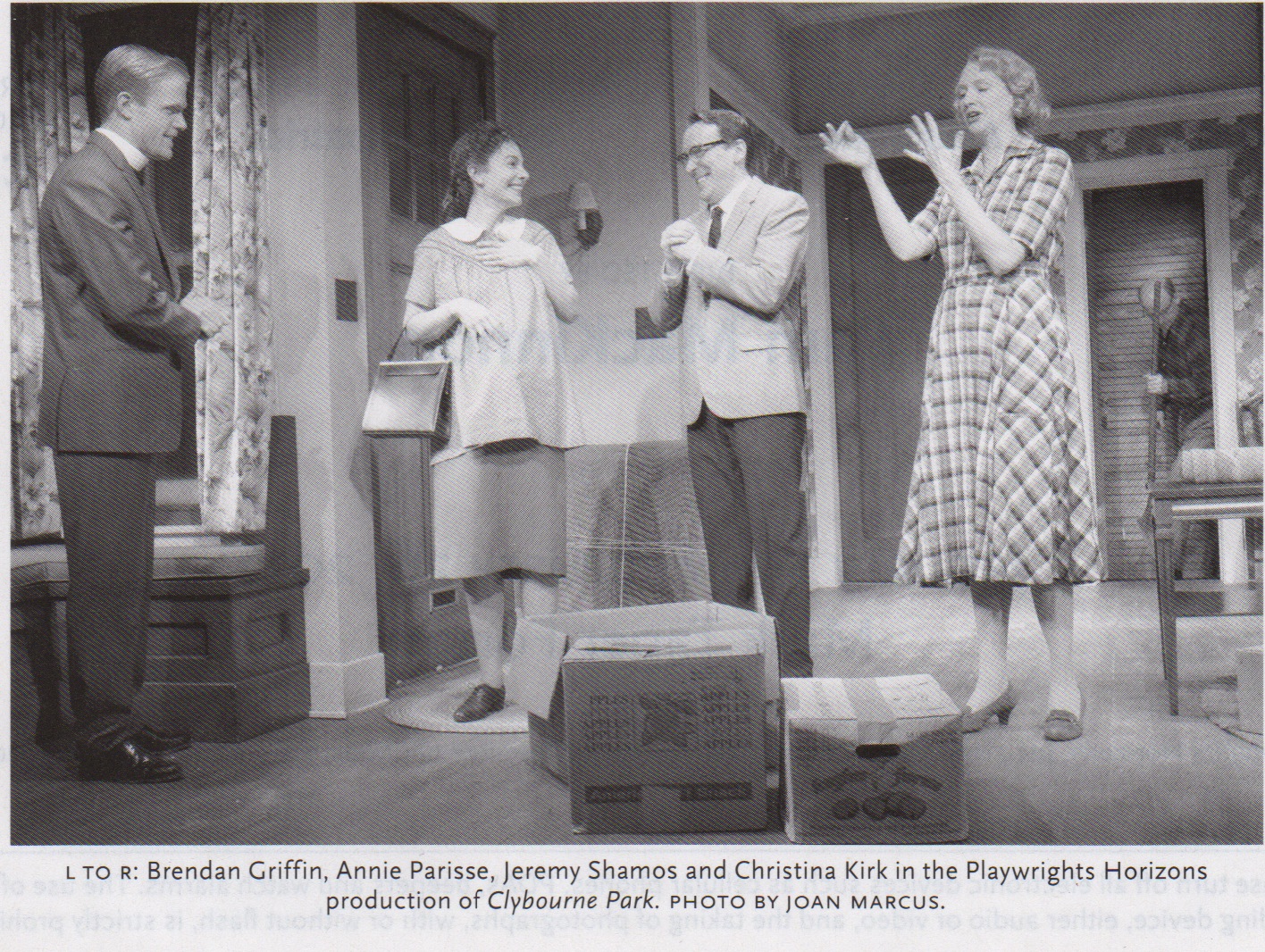
Now enters Clybourne Park. It  is a play that is in two parts. The first part takes place in 1959 and the 2nd part in 2009. Both parts take place in the home of Bev and Russ, the couple who had sold their home to the Younger family.  Bev and Russ are in the midst of moving boxes being helped by their Black house maid, Francine. Karl and his deaf pregnant wife visits them, supposedly right after visiting the Younger family.  Karl tries to convince Bev and Russ to use a loop hole not to sell the house to the Younger family.

The next act takes place in the same home, but in 2009. This time the actors who play Karl and his deaf wife, now play the new owners of the house. They are sitting with the actors who had played the Black house maid, Francine and her husband in the 1959 scene.  The roles are switched and they are now part of the neighborhood association. 

Both couples are accompanied by lawyers. The issue is that Karl and his wife want to remodel the home and it will be a few feet higher than any other house in the neighborhood. Francine doesn't want to lose the sense of history the neighborhood has to offer that she and her family experienced since her Aunt Lena moved in back in 1959.

The 2009 Karl uses the same argument that he used with the Lena Younger and her son Walter.  In 1959, Karl had tried to convince them that they would not be happy in a neighborhood of people who were not the same.  They don't like the same things, different culture and for example, they wouldn't be able to eat the things they liked because they wouldn't be able to buy them at the local Gelman's grocer. Francine's husband, who dropped by to pick her up said deadpan, he would not be happy if Gelman's didn't sell chitlins or pigs feet.  It was funny that in the 2009 scene, they said Gelman's was now the location for Whole Foods.

Back to 1959.  Bev and Russ want to move and escape the reminder of the tragedy that begins to unfold. Their son had returned from the Korean War and was accused of committing war atrocities. As a result of the shame, he commits suicide. The neighborhood shy away from Bev and Russ.  So the last thing they want to do is stay in that house to help neighbors who didn't really help them before.

Back to 2009.  Karl and his wife think that they are not welcomed because of racism, but Francine says the issue is the lack of the sense of style of the home they will be building.

This is a play that portrays the racism of the early years by otherwise very nice White people and how the Blacks at the time had to deal with it. It was also funny as it dares cross the line of political correctness. It is tragic, funny, thought provoking and unique in the way the actors portrays different roles in the two eras within the play.

We would not only see it again, we would see it again later that day. It got a standing ovation from us.