Saturday, December 11, 2010

Opera-Rigoletto


Rigoletto is an opera that takes human frailty to the extreme.  Perhaps that is the basis for Opera anyway.  Arias and duets are sung with great emotion as the characters are swept up in the drama of rage, jealousy, despair, deceit and frivolity. 

Rigoletto the main character, is a Duke’s jester.  He entertains the Duke, but does so at the expense of other courtiers.  As a result, he makes enemies who wait to take revenge. The Duke is a philanderer who is accused by Count Monterone that he has shamed his daughter.  Rigoletto insults the Count and in turn, the Count curses Rigoletto.  Rigoletto is concerned because he also has a daughter who he has kept sheltered over the years.  The duets between Rigoletto and his daughter Gilda, are absolutely beautiful.

Gilda adores her father and obeys him by staying home, leaving only to go to church.  But at church, the Duke spots her and tries to win her heart.  Of course she falls hopelessly in love with him. 

In the meantime, the courtiers spy on Rigoletto and see him with Gilda.  They think Gilda is his lover and they kidnap her, taking her to the Duke.  Rigoletto discovers what they have done and he rushes back to the palace.  Gilda flings herself on her father, confessing her shame by the kidnapping and liaison with the Duke.  

Rigoletto takes Gilda home to dress her in men’s clothes so that she can escape the shame of Mantua.  He then hires an assassin to kill the Duke for shaming his daughter.  During a dark and stormy night at an inn, Gilda overhears the assassin’s plot.  To save her love, she pretends to be the Duke and is killed instead.  When Rigoletto returns to the inn, he is overwhelmed with grief when he discovers the body of his daughter.  In the background he hears the dang Duke singing.  The curse!


I thought the singing and the bright costumes were beautiful.  But I couldn’t identify with the characters to become emotional.  Rigoletto was mean to others and a bit twisted that he control his daughter’s life so much that she didn’t know any better and fell for the Duke who didn’t deserve her sacrifice.

Would we see it again?  Of course, of course.  It is a Verdi classic and the music transcends the characters’ frailties. 

George Gagnidze plays Rigoletto, Sarah Coburn plays Gilda and Gianluca Terranova plays the Duke.  All well done.  

Saturday, December 4, 2010

Opera-Lohengrin

The first Wagner Opera we attended was Siegfried.  It was okay.  Partial to Italian or French operas, we wanted to expand our horizons so to speak and attend another Wagner opera.

First, let me give you a brief synopsis on the opera, then recap what we actually saw.  Lohengrin is a fantasy, fairy tale story about romance and miracles.  King Henry arrives in Brabent to expel Hungarians from his realm, but also judge accusations about the disappearance of the young Duke Gottfried.  Count Telramund is the Duke’s guardian and accuses the Duke’s sister, Elsa of murdering her brother.  Elsa proclaims her innocence and trusts in God to send her a knight to champion her innocence.  On the river, a knight in shining armour appears on a boat drawn by a swan, to accept the challenge.  One thing he asks is that she never asks him his name.  He challenges Count Telramund and defeats him.  The knight then asks Elsa to marry him, but again, she is not to ask him ever, for his name. 

Ortrud is a witch and companion to Count Telramund who are both exiled while wedding preparations for the knight and Elsa are underway.  Ortrud casts suspicions in Elsa’s mind about the knight’s secretive manner.  During their wedding night, Elsa is begging for the knight’s name, when Telramund and 4 henchmen try to assassinate the knight.  During the fight, Telramund is killed.  Saddened by the events, the knight decides to reveal himself to Elsa and the King.  He is Lohengrin the Knight of the Holy Grail.   He has to return to his duties but wanted to stay long enough to marry Elsa. 

Ortrud then appears saying that she cursed young Duke Gottfried, turning him into a swan.  Lohengrin prays and the swan turns back into the Duke.  A dove leads Lohengrin back to his castle.  As he departs, Elsa is so distraught, she collapses and dies. 

So how does this compare to what we saw?  Instead of taking place in the time of knights and castles, the opera is set during World War I.  The set is a bombed out building used as a field hospital.  In a tent, we can see backlit shadows of a doctor sawing the leg from a wounded soldier who eventually dies.  The scene progresses and Elsa is asking for a champion to help proclaim her innocence.  The dead soldier from behind the tent, raises from the dead.  He comes out and in place of his amputated leg is a prosthetic, shaped like a knight’s armour.  At the end of the opera when he supposed to float back to his castle, he instead walks back to the tent, lays down and dies.  Elsa still dies too.

I preferred the romantic, fairy tale version. It best fits the original intent of the opera with fantasy and magic.  The version we saw was doubly tragic.  It was long, but we did find the opera to be more enjoyable than Siegfried.  We also discovered surprisingly, the most well known aria from this opera is the Bridal Chorus, most commonly played at today’s weddings.

Sunday, November 14, 2010

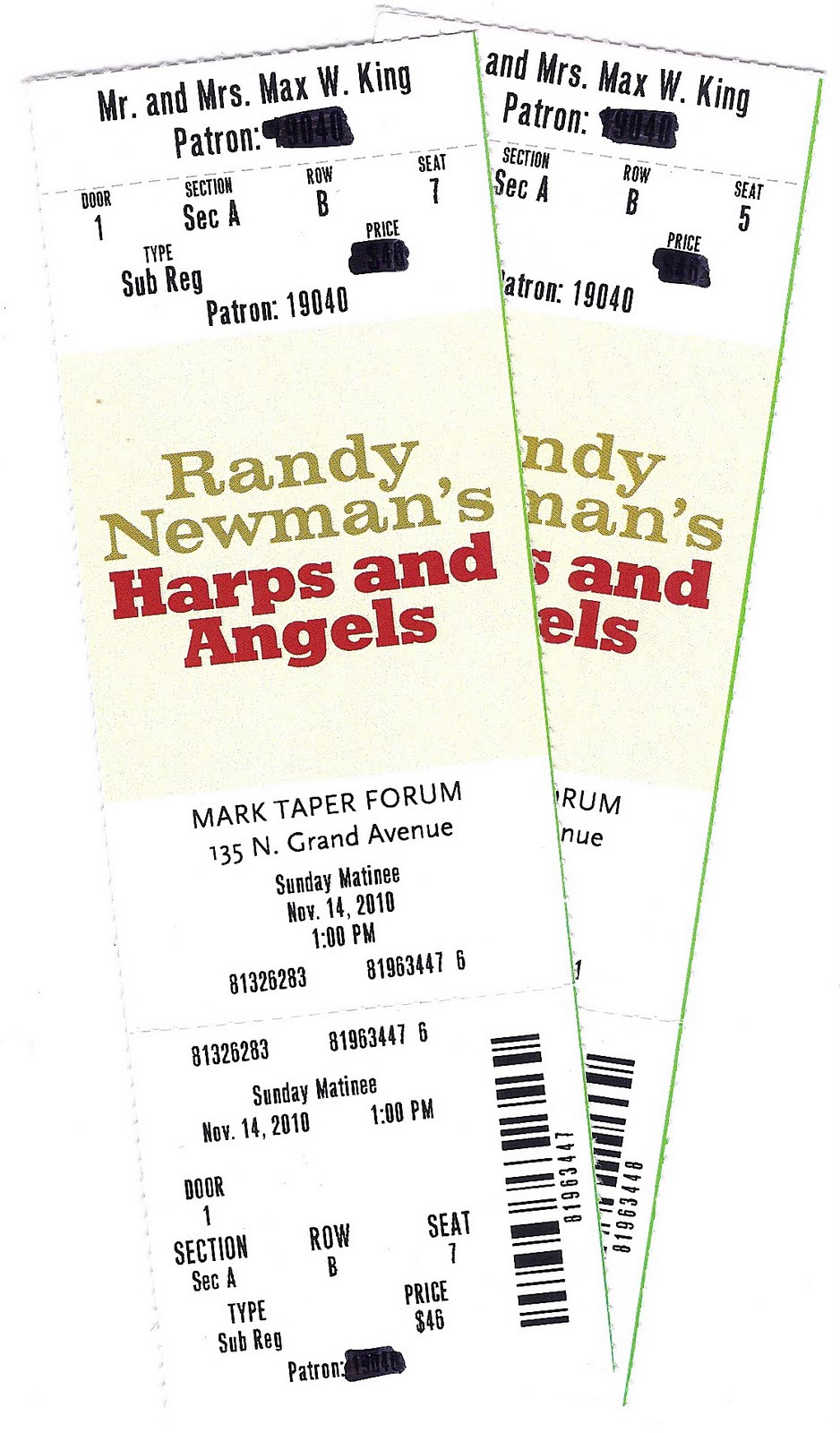
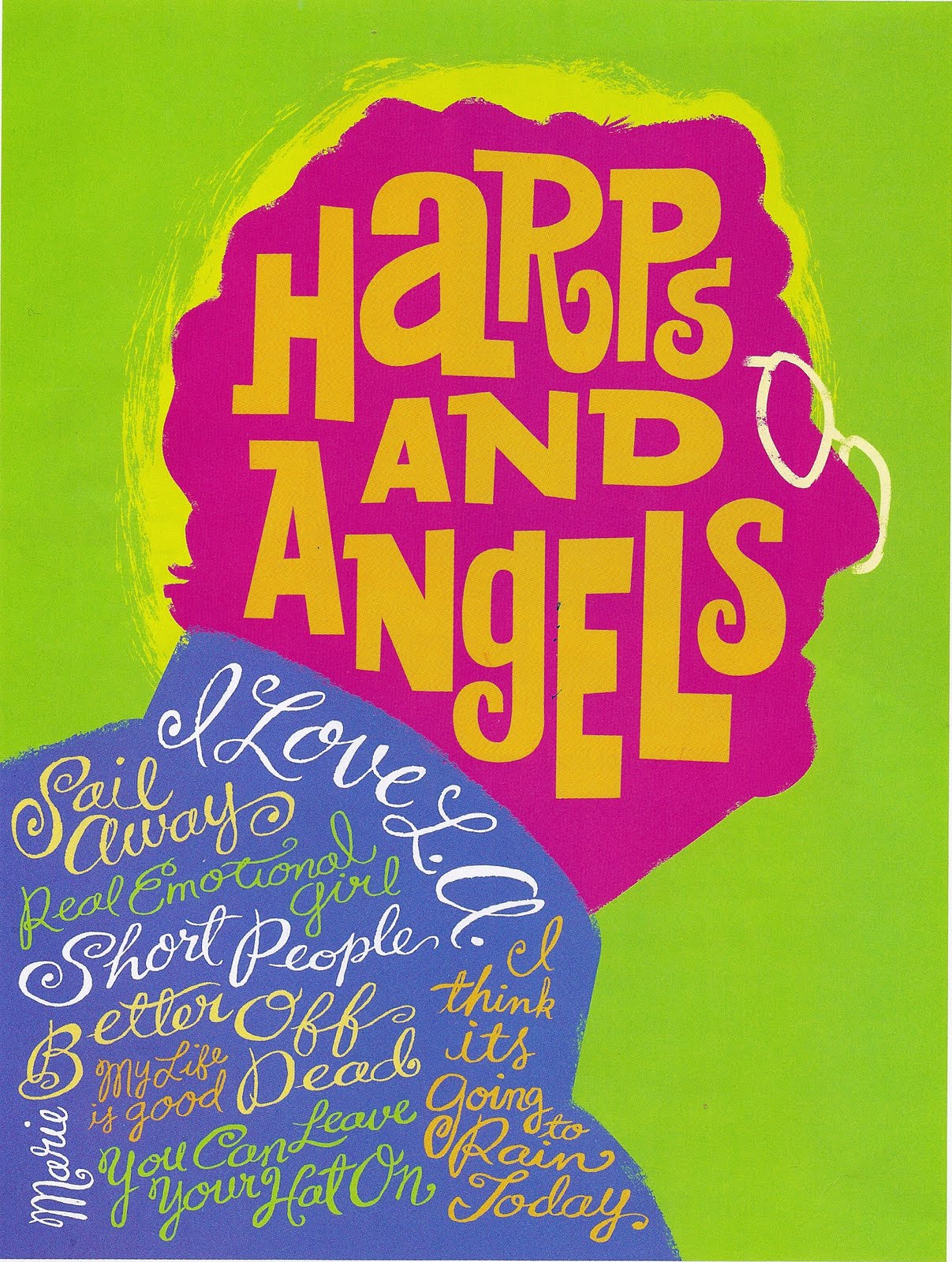
Harps and Angels


We were looking forward to a whimsical, memories from the past musical experience.  For those of you who have been around for a while, songs such as “A Fool in Love”, “I love L.A”, and “Sail Away” may bring back memories from the 70s and 80s.  “Short People” is as outrageously prejudiced today as it was back when it was first released…and just as funny. 

We’ve seen Smokey Joe’s Café and so we were looking forward to a similar rendition of Randy Newman’s best songs by a musical cast of 6 singers, no dialog.  Included in the musical cast is Michael McKean who some of you old-timers might remember as Squiggy from the sitcom, Laverne and Shirley. 

The experience fell short.  The cast of singers was good, but not great.  The saving grace was the great music of Randy Newman, which is entertaining today as it was years ago. He does have recent recordings, but I am not familiar with them.  No, we would not see this one again, but we did enjoy the show.  


Sunday, October 24, 2010

Leap of Faith

This musical stars Raul Esparanza and Brook Shields.  Who knew that Brooke could sing?  I was doubtful, but I was pleasantly surprised.  We’ve all seen this type of plot before.  A handsome scoundrel con man comes into town, sweeps a single mother off her feet, struggles with his life’s direction, finds love and settles down. 

Raul plays Jonas Nightingale who leads a troupe of entertainers across the Midwest to hold the tent revivals where they whip the audience into religious frenzy when he proclaims their private weaknesses and prays to redeem them.  The con is that members of the troupe discretely overhears audience conversations or investigates people, especially the wealthier population.  They then relay the information to Jonas who proclaims that he obtained this information through divine intervention. 

Another attraction is the miraculous healing.  For example, as she walks into the revival tent, a poor old lady is pushed into a wheelchair.  She sits in bewilderment as Jonas lays his hands on her forehead crying out, begging her to walk.  Of course she can walk…but no one else in the town knows because she is a visitor from another town.  In the meantime, the gospel singers are banging tambourines, waving their uplifted hands, singing “Allelelujah”!  The singing throughout the show is so absolutely uplifting,  the audience wants to jump up and wave their hands too.

The problem the town faces is that they have little money because most of what they earn goes into drilling for water because of the drought conditions they are facing.  So the struggle Jonas faces is the fact that he is fleecing money from a town with little money, struggling to survive. 

Brooke plays Marva, a single mother of a young boy named Boyd.  She is a street smart waitress in the only café in the small town.  Marva falls in love reluctantly with a man who arouses her suspicions.

Years before, Marva’s husband died in a car crash.  Boyd was also in the crash causing paralysis from the waist down.  Jonas sings, “Death is a breeze.  Death is a breeze because no one has come back to complain.  But Life is the really hard part.”  Boyd believes Jonas is going to provide a miracle and you guessed it….Boyd walks and everyone lives happily ever after.  The plot maybe old, but the excitement and top notch entertainment is worth seeing again. 


 As the cast took their bows to the standing ovation, Brooke asked to make an announcement.  I thought, oh she is going to make a request for contributions for AIDS or some Performing Arts association.  But it turns out that it was the last performance in L.A. and it was also Raul’s birthday.  So 2000 members of the audience, cast and stage hands sang Happy Birthday to Raul as he stood stunned and teary eyed.  It was fun. 

Saturday, October 16, 2010

Il Postino

Ah, the first opera of the 2010/2011 season starring Placido Domingo.  He plays the role of Pablo Neruda, a poet from Chile, exiled because of his politics.  Pablo won a Nobel Prize for literature in 1971.   He is known for reading his poems to large communist gatherings and was actually a senator for the Communist party.  He returned from exile after 3 years, living in his country continuing to write his poetry until his death in 1973 at the age of 69 years old.  

We normally do not like modern operas because of an experience years ago attending a modern opera called Regina, performed at the Orange County Performing Arts.  We went with another couple, dear friends of ours who are always a lot of fun to be with.  The opera was awful, but we were having so much fun anyway.  Regina just could not compare to the classic operas.  For heavens sake, the characters talked with a southern drawl and then would break out into an aria.  Operas should be sung in Italian, French, Spanish or German.  People around us were leaving throughout the performance, but we kept hanging in there, thinking it had to get better.  It didn’t.  A week later, I had t-shirts made for our friends that read, “I survived Regina” to remember the experience.

I digress. Back to Il Postino (The Postman).  Pablo, exiled from Chile seeks refuge for a short while in a small Italian island of Cala di Sotto.  The other main character is Mario, performed by Charles Castronovo.  Mario is the young postman who delivers the mail to Pablo from many of his admirers worldwide.  Mario is rather aimless because he can’t move to America like his brothers and hates fishing, so he rejects being a fisherman like his father.  Over time, Mario interacts with the gracious Pablo, learning more about poetry from the master.  He uses his newfound knowledge to write poetry to win his love, Beatrice.  He eventually wins the hand of Beatrice and marries her.  But he meets his death when he attends a Communist gathering to read his poetry and is accidentally shot when a riot breaks out. 

It was a beautiful opera both visually and through its music.  Scenes from around the island were superimposed in the background to provide inspiration for Mario’s poetry.  The sound of the water as the surf meets the beach, the fishermen in their boats, hills and mountains overlooking the sea.  Music is mixed with the love and creation of poetry.  Placido is yes, past his prime, but he was excellent.  He was excellent, keeping in mind that he underwent cancer surgery a few months earlier.  He is an artist to be admired and we will take every opportunity to attend every opera that is performed by Placido because he is such a legend. 

Our rating of "Would we see it again", is a poetic "Yes"!

Sunday, September 5, 2010

The Glass Menagerie

This is a play by Tennessee Williams that finally changed his life from a struggling writer to a world renowned success.  It is such a classic, so Max and I were trying to remember the plot and if we saw a movie version of it played by Marlon Brando or Paul Newman years ago.

The play has four characters and a haunting fifth.  Amanda is the mother who lives with her son Tom and her daughter Laura in a simple, dark apartment in New Jersey.  Amanda is a fading beauty who constantly lives in her past glory as a southern belle who was so sought after, she had “…entertained 17 beaus at one time”.  She loves her children dearly, but she is also very disappointed in them. 

Tom, a warehouse worker also writes in the evening.  Her disappointment in him is that he shows signs of taking after his father who had drank a lot and finally left them 15 years before.  “He worked as a telephone man who fell in love with long distance”.  The father’s picture hangs on the wall bringing them pain and arguments every time they refer to him. 

Amanda, Tom, Laura
Her disappointment in her daughter Laura is that she is painfully shy, the antithesis of Amanda when she was a young girl.  Laura was enrolled in business school, but during a typing test she was so agitated, she threw up and would never go back again.  She has a slight limp that contributed to her shyness and low self-esteem.  Her only joy is her love for her brother and her collection of glass creatures that Amanda called the Glass Menagerie.

After Amanda’s constant harping, Tom invites a fellow warehouse worker Jim O’Connor, to dinner in the hopes that they would find a suitable husband for Laura.  Jim turns out to be the boy that Laura had a crush on in high school.  Laura was absent for a while from school and when Jim asked where she had been, Laura replied that she had pleurisies.  He thought she said Blue Roses and gave her the nickname since then.  Tom is a nice person who charms Amanda and encourages Laura to be more confident.  We thought great…this guy is going to save them from a hopeless existence, but sadly he already had a girlfriend. 

Tom, who was terribly unhappy with his life, flees to travel the world to seek the adventure he was craving.  Unfortunately, he doesn’t find happiness as he is haunted by his mother and mostly his sister who have to fend for themselves.

The play is dreary, sad, haunting yet funny at times.  Judith Ivey who played the role of Amanda was excellent, excellent, excellent.  We understand why this is such a classic that has continued to entertain audiences many years later.  It deserved our standing ovation and it passed the test of whether we would see it again.  Yes, we would!

Saturday, July 24, 2010

Pageant of the Masters 2010

For several years we have attended this festival that is held every summer in Laguna Beach.  We’ve invited several different family members to introduce them to this art form.  It started back in the early 1900’s and has increased in attraction world-wide and the sophistication on how it is presented.  We normally attend on the weekends and it is a sold-out event.

Each year is a different theme and this year it was Eat, Drink and be Merry.  Different art forms relating to the theme range from figurines to sculptures to paintings.  Artwork is recreated using human volunteers who would hold a brief pose for the audience to study.  Introducing the artwork, there is an entertaining narrator explaining the artist and the motivation for the art piece.  Then while the human volunteers pose, the live orchestra plays a short musical piece.

We think the more interesting part of the presentation is when they show how a painting is created.  First there is a frame and the people with makeup and costumes are moving about and put into place.  Then the stage goes pitch black and when the appropriate stage lighting comes back on, there is a stunning re-creation of the painting. 

We have been entertained by this annual event for many years, but it is getting to the point that we are getting bored.  So we are not renewing our membership for next year.  Instead we will take a hiatus for a year or so and attend in the future when the interest arises.