Sunday, September 30, 2012

November


Performed at the Mark Taper, this farce is about a president who thinks he will lose the election and is trying to make enough money for his Library.  Ed Begley Jr. plays the president, Charles Smith, and Felicity Huffman plays his gay speechwriter, Clarice, that he relies on heavily.

The role of Charles was rather silly as he schemes to blackmail the National Association of Turkey Manufacturers by not pardoning the selected turkey unless they contribute heavily to his Library.  Clarice was rather annoying because she is supposed to be sick and her sniffling, coughing and sneezing got on my nerves. 
I hated it, really.  Max felt the same way and he doesn’t think Ed Bagley is a good actor at all.  He puts Ed in the same league as Bill Pullman who he dislkes.
I should have known better.  The screenplay is by David Mamet who I’ve disliked ever since Sophia (the goat).


Saturday, September 29, 2012

Opera-The Two Foscari


Today, we left much earlier than usual because Carmegeddon was in full swing.  A portion of the 405 Freeway was shutdown far beyond where we would be traveling, but the closure could increase traffic flow in other areas of L.A. as people use alternative routes.  We got there with no problems, so that allowed us to relax and have dinner at First and Hope at a more leisurely pace. 

This time we ordered a wedge lettuce salad and short rib sliders. I always like the salad, but the sliders were okay.  Not enough filling and it had bean sprouts in it. Yech.

After dinner we went to hear a portion of the lecture by James Conlon, which I didn’t get much out of since we came in the middle as he played bits and pieces of the upcoming Opera.

As we waited for the performance to begin, we see Pau Gosal towering over everyone else as he and his wife go to 2nd row center, far better seats than ours.  How did that happen? ;-)

During intermission, we observed Pau head outside the lobby area and he was so gracious. So many people wanted to talk to him or have their picture taken with him and he did accommodated everyone with a smile.

Back to the Opera.  Placido Domingo starred in this production that takes place in Venice.  His son, Jacopo is unjustly accused of a crime against the state.  Placido plays his father, the Doge of Venice.  He tries to help his son, but cannot due to his position.  Jacopo’s wife, Lucrezia pleads for mercy with the court and Foscari.  It is particularly heart wrenching because she brings her children who also kneels in court begging for clemency for their father. 

But the court finds Jacopo guilty and exiles him with no chance of seeing his family again.  When the boat departs Venice, he commits suicide because of his despair of leaving his home and family.  It is ironic that when the boat departs, a messenger arrives with evidence that the charges against Jacopo are false. 

Foscari is deeply saddened and there is increased pressure when the Council demands his resignation. Foscari then dies of a broken heart with the loss of his position and his son, Jocopo.  Placido is wonderful in this role and there are so many wonderful arias in this Opera.  This is a new Opera for us that we will see again.

Saturday, September 22, 2012

Opera-Don Giovanni


This is a Mozart opera and to us, there wasn't a single aria that soared and captured our hearts.  The songs were entertaining, but not captivating as in Puccini or Verdi operas.  We prefer the Italian Operas.

Don Giovanni is a nobleman cad, master to Leporello, known as nowadays, his "Wingman".

He crosses the line when he attempts to rape Donna Anna and as he tries to get away, winds up killing her father, the Commendatore.

Lessons in morality figure predominantly in this opera.  When we were going to see this Opera, Ron sent me a message saying, "Ah, the Stone Guest".  Giovanni doesn't regret his actions.  When he is hiding in the grave yard he is laughing and bragging about his exploits.  He then hears the voice of the Commendatore who warns him that his laughter will be silenced by the morning.  Cocky, Don Giovanni invites the statue to dinner.  The "Stone Guest" is the grave yard statue of the Commendatore who drags Don Giovanni into hell when he does not repent his sins.

The opera was fairly long, 3 hours.  Max gave it a B-.  I hope Mozart doesn't haunt us.


Sunday, August 5, 2012

Red


Alfred Molina delivers an intense performance playing the character of Mark Rothko, a celebrated artist at the peak of his career who was still tormented by his artistry and commitment to the message of his works.

He is a Russian artist who rises as in his career in the late 1950’s trying to deliver his anti-establishment message in his works.  I find it interesting that this is one of the few great artists in history who is acclaimed during his life.  Usually, artists die tormented and in despair.  They become famous after their death.  Anyway, the first Rothko I remember seeing was in the English Garden museum in Munich.  His works are usually huge canvases with blocks of contrasting colors, usually primary colors.  Red is one of them.

He is an obnoxious artist who treats his assistant with disdain.  The play takes place in his studio as he debates his commission to create a series of paintings, which will be displayed at the new Seagram Building’s restaurant, The Four Seasons.  He has risen to fame as an anti-establishment artist whose work will be displayed ironically, in a luxury environment.  It was reported that he wanted to create a series of paintings “that will ruin the appetite of every son-of-a-bitch who ever eats in that room”.

I would see this play again and again because there are so many witty, intellectual lines.  I even bought the screenplay from Amazon.  Very good and we both enjoyed it.  Alfred was perfect in this role.  We hated and admired his portrayal of Rothko.

Sunday, July 22, 2012

Warhorse


Mom and I went to see this performance when she visited the mainland.  She came to California the beginning of the month, then went to Omaha, then returned to California the latter part of the month before going home.  Before she went to Omaha, we watched the movie, Warhorse.  So seeing the play gave us a different perspective of the same story.

This story takes place during WWI in England.  To spite his brother, a man buys a prized stallion with the last of his money.  His son takes care of the colt and when they are challenged with the possible loss of their farm, he trains the race horse to plow a field.  War starts and the horse is commissioned to be part of the English army as they travel to the war trenches in France.  The horse goes from one loving owner to another during the war as the boy joins the infantry trying to find his horse. 

The most compelling scene in the story is when the horse flees from the bombardments and gets tangled in the barbed wire between the warring trenches.  The English and Germans hear the whinnying of the horse.  Soon, two soldiers from each side cautiously crawl to the horse.  Then they work together to untangle the horse, finally freeing it.  The English soldier wins the horse in a coin toss and brings the horse back to the medics where the boy happens to be treated for burns around his eyes.  The doctor is about to shoot the horse because of his wounds, but the boy hears about the rescued horse.  Believing it is his horse, the whistles and the horse responds, saving himself from being killed.

In the play, the horse is actually a frame with puppeteers that work the feet and head of the horse.  At the beginning of the play, a couple of puppeteers work the frame of the colt, but at one point the grown horse emerges and the impact brought applause from the audience.  The horse was life size.  The back and front hooves were actually 2 different people in the frame and their feet manipulated the hooves.  A third person had two poles that manipulated the movement of the head.  At first, the people interfered visually, but soon we saw beyond it.  They movements conveyed the breathing and muscle movements of a horse.  It was amazing and wonderful. 

Part of the war scenery was off stage right near us in front of the first row.  When soldiers jumped into the trenches, they were actually jumping right in front of us.  Fun.  Enjoyable play and movie with a wonderful ending.  Feel good movie that is great for the whole family despite the fact that it is about war.

Sunday, May 27, 2012

Los Otros


The theme of this play is described as being about immigration and I thought, "Oh great". Something that will be about the poor Mexican immigrants from the biased bleeding hearts liberal point of view. But it wasn't. It is about a man and woman (no names, just Man and Woman) who separately tell/sing about their experiences. Their experiences and stories were touched by immigrants.

It started off a bit strange.  A woman in her mid-forties dressed only in a slip, starts her story as a little girl back in 1952 in a small town near San Diego. She and her girlfriends would always go to a train tunnel to watch the trains trundle past. One day, a man and his wife with their baby strapped to her, jump from the slow moving train.  The girls watch from the shadows as the family leave the tracks and find a cave to hide. Claiming the family as theirs, the girls bring sacks of food for them.  This goes on for 3 days until they see a produce truck with people in the bed of the truck. Amongst the huddled people is their family.  Broken hearted, the girls watch the truck drive away.

She tells stories of her life as she gets older, including the time her ex-husband George helps her get a maid in Tijuana. Another story is when she seduces a young field laborer while they were eating at a late night taco stand while she was in a drunken stupor. I didn't enjoy this part, thinking she was going to be hurt or worse.

Then a Hispanic man comes out to sing/tell his story. First he clarified that he is a US citizen, thank you very much. His mother left Mexico after a terrible hurricane leveled her village. He is now a gay, 70 year old accountant. He tells the story of when he was a young boy, his family would drive north every summer to pick plums for a bitter, crippled landowner who is waiting for his son to return from the war in the Pacific during WWII. During that summer, as the war was ending, the Man discovers his sexuality.

In his later years, his partner of 15 years brings his ex-wife into their home.  The Man is okay with the wife coming into their lives.  In fact, she becomes the "wife" for both men. The Man's partner collects art, but it was too much. The Man was going to leave his partner due to "elegant hoarding". But, he doesn't. More years go by and the Man is showing signs of Alzheimer's. His partner of now 30 years is helping him and his ex-wife comes on stage. It is the Woman from the earlier part of the play.  The Man's partner is George, the ex-husband of the Woman.

It was a very different delivery of their stories through singing and talking. But I got into it because the stories were compelling. Max said he liked the Man better than the Woman. He gave the play B-. 

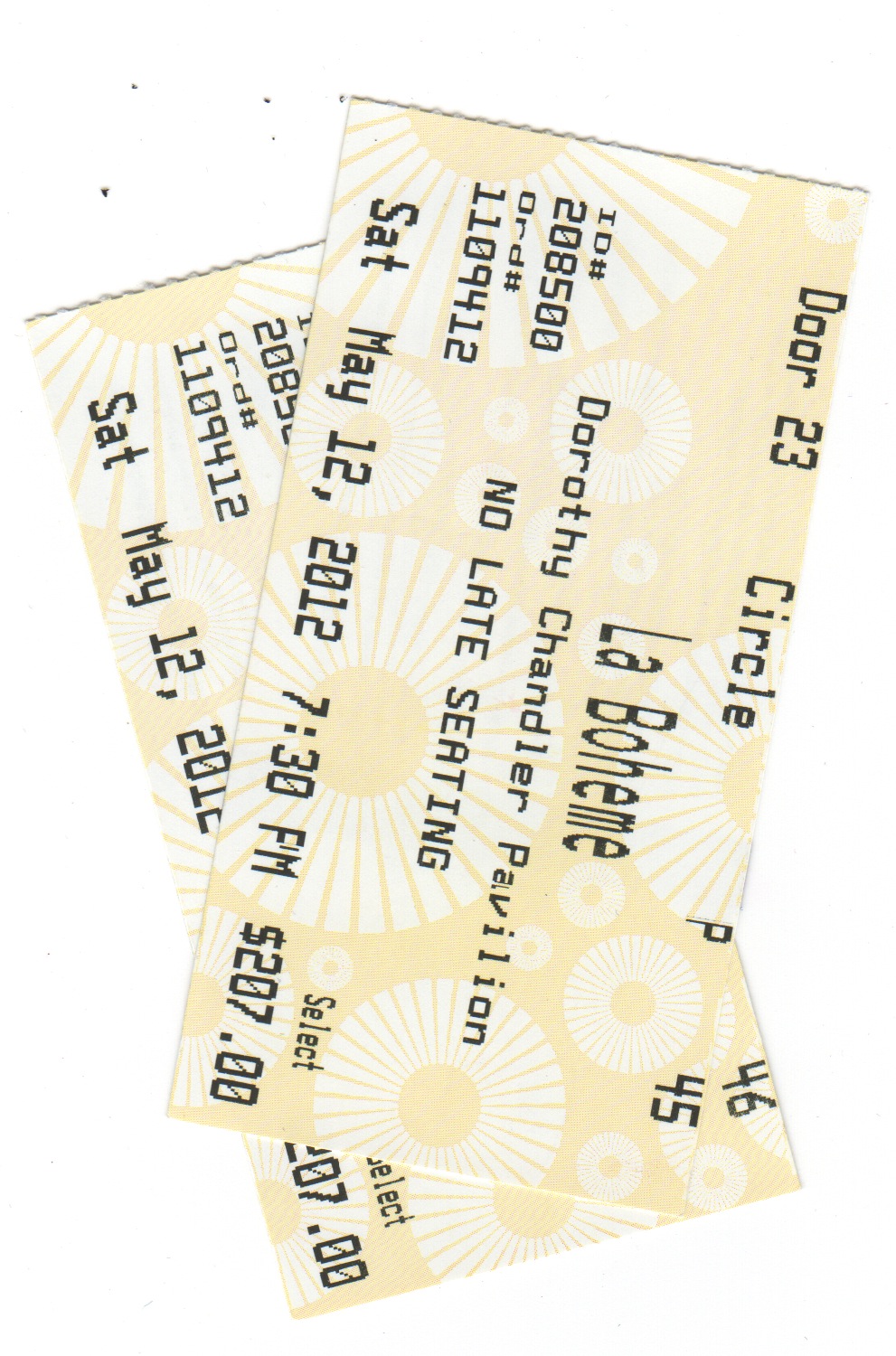
Saturday, May 12, 2012

Opera-La Boheme


Ah, another performance of La Boheme.  We will never tire of Puccini’s famous classic.  Boy meets girl, Boy loses girl, girl dies story line.

Mimi and Rodolfo meet when Mimi, his neighbor, knocks at his door.  Her candle is blown out by the wind and as they look for her dropped key, they fall in love.  The aria at this point is one of the the most beautiful.

In the second act we meet the incomparable Musetta.  I think Musetta is a much more dynamic role and if I were an opera singer, I would rather play her.  Rudolfo, Mimi and their friends go to a cafĂ© to celebrate the holidays. The other part of this act that I love is the townspeople, vendors and toy sellers’ gaiety around them.  It is one of the lighter moments as Musetta and Marcello ignore one another but at the end of the second act, they fall into each other’s arms.


In the 3rd and 4th acts, Mimi’s health is deteriorating.  She wants to break up with Rudolfo because of her health and he is also jealous.  She confides with Marcello and Rudolfo comes onto the scene, overhearing her distress.  They are torn, but they get back together.  At the end of the 4th act, Mimi returns to Rudolfo and passes away quietly.  It is always a tear jerker when Rudolfo discovers Mimi’s death and he wails in grief.  Argh.  It always gets me.

Beautiful and memorable and I know this won’t be our last La Boheme.  This would definitely be one of the plays I would recommend to a first-timer to become oriented with Opera by starting with one of the best.