Saturday, February 11, 2012

Opera-Simon Boccanegra


This is the first time we saw this opera by Verdi.  We are not familiar with the story, but all we knew is that Placido Domingo played the lead role of Simon.  It is such an honor to hear the master sing.  He could be very well sitting back being the Director of the LA Opera and many other opera houses around the world, but he stays on top of his game by performing periodically.

In 1339, Simon is brought into power as the Doge of Genoa who was just a sailor and mercenary.  This is due to the influence of Paolo Algiani who is a power in the leading party.  Simon agrees so that he can be worthy enough to marry his love, Maria.  They already have a daughter Amelia.  But Maria dies and their daughter vanishes.  Maria’s father, Fiesco doesn’t forgive Simon for Maria’s death and the disappearance of his granddaughter.

25 years later, Simon’s daughter Amelia grows up in the Grimaldi family who had been exiled.  Fiesco is her guardian, but doesn’t know who she really is.  I don’t remember how she came to be in the Grimaldi family, but it does sound a bit farfetched that Fiesco doesn’t know who she really is if she has the slightest resemblance to her mother.  But ah, this is an opera. 

Simon pardons the Grimaldi family and promises Amelia to Paolo.  But as he gets to know Amelia and she reminisces about memories as a girl, he realizes who she really is.  He then dismisses the promise of marriage to Paolo so that she can marry her true love, Gabriele Adorno. 

Paolo, seeking vengeance, orders his men to kidnap Amelia, but they fail.  Simon suspects Paolo, so curses the kidnappers and orders Paolo to do the same.  To keep from incriminating himself, Paolo reluctantly curses himself. 

So then Paolo poisons Simon. Paolo is found out and is led away to be executed.  Simon eventually dies, but only after he belts out a dying aria and blesses the marriage of Amelia and Adorno.  He also requests that Adorno succeed him as the Doge. The crowd cheers the new Doge as they respect Simon’s dying wish. 

Beautiful performance by Placido. I don’t remember the others to comment, because Placido was the memorable star.


Sunday, January 15, 2012

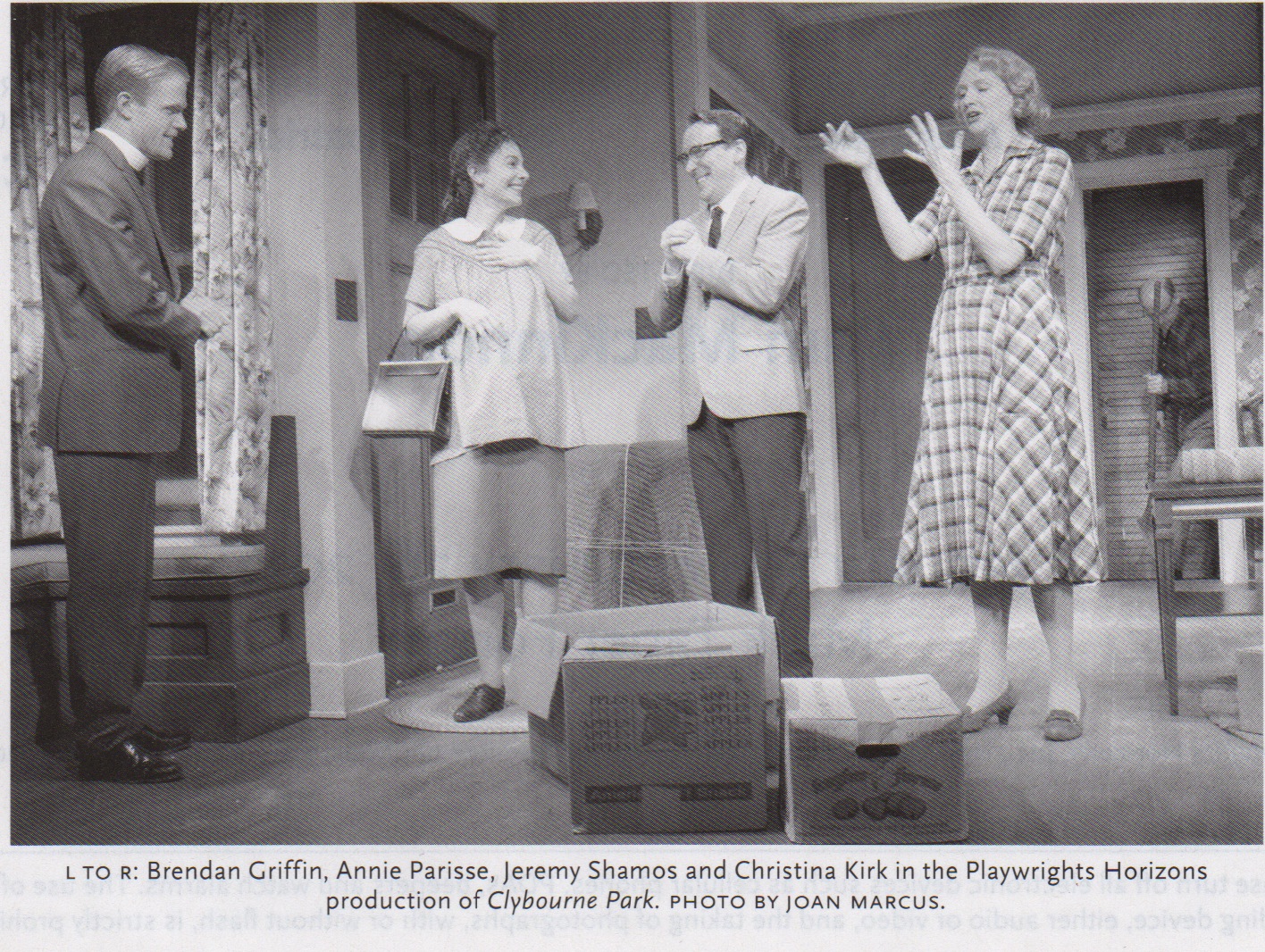
Clybourne Park

There were a few empty seats and we haven't heard much about this play, so we weren't quite sure what to expect. Maybe not much. But it turned out to be thoroughly enjoying. It was shocking, funny and a great day at the theatre.

This play is an extension of the play, "A Raisin on the Sun", which coincidentally is playing in Hollywood at the Geffen Theatre. That classic play is about the Younger family in 1959 who saves and struggles to move out of the Chicago Projects. They are able to do so because of the Life insurance check the mother Lena receives when her hard working husband passes away. They put a down payment on a house in Clybourne Park, an all white neighborhood.

Karl, a member of the Clybourne Park neighborhood "welcoming committee" tries to buy them out to avoid having a colored family move in, affecting the quality and value of their neighborhood.  In the "A Raisin in the Sun", the family declines even though they are tempted.  As the hopeful end of the play, the moves to their new life in their new home. 

Now enters Clybourne Park. It  is a play that is in two parts. The first part takes place in 1959 and the 2nd part in 2009. Both parts take place in the home of Bev and Russ, the couple who had sold their home to the Younger family.  Bev and Russ are in the midst of moving boxes being helped by their Black house maid, Francine. Karl and his deaf pregnant wife visits them, supposedly right after visiting the Younger family.  Karl tries to convince Bev and Russ to use a loop hole not to sell the house to the Younger family.

The next act takes place in the same home, but in 2009. This time the actors who play Karl and his deaf wife, now play the new owners of the house. They are sitting with the actors who had played the Black house maid, Francine and her husband in the 1959 scene.  The roles are switched and they are now part of the neighborhood association. 

Both couples are accompanied by lawyers. The issue is that Karl and his wife want to remodel the home and it will be a few feet higher than any other house in the neighborhood. Francine doesn't want to lose the sense of history the neighborhood has to offer that she and her family experienced since her Aunt Lena moved in back in 1959.

The 2009 Karl uses the same argument that he used with the Lena Younger and her son Walter.  In 1959, Karl had tried to convince them that they would not be happy in a neighborhood of people who were not the same.  They don't like the same things, different culture and for example, they wouldn't be able to eat the things they liked because they wouldn't be able to buy them at the local Gelman's grocer. Francine's husband, who dropped by to pick her up said deadpan, he would not be happy if Gelman's didn't sell chitlins or pigs feet.  It was funny that in the 2009 scene, they said Gelman's was now the location for Whole Foods.

Back to 1959.  Bev and Russ want to move and escape the reminder of the tragedy that begins to unfold. Their son had returned from the Korean War and was accused of committing war atrocities. As a result of the shame, he commits suicide. The neighborhood shy away from Bev and Russ.  So the last thing they want to do is stay in that house to help neighbors who didn't really help them before.

Back to 2009.  Karl and his wife think that they are not welcomed because of racism, but Francine says the issue is the lack of the sense of style of the home they will be building.

This is a play that portrays the racism of the early years by otherwise very nice White people and how the Blacks at the time had to deal with it. It was also funny as it dares cross the line of political correctness. It is tragic, funny, thought provoking and unique in the way the actors portrays different roles in the two eras within the play.

We would not only see it again, we would see it again later that day. It got a standing ovation from us.


Sunday, January 8, 2012

Burn This


I am catching up on all the plays and shows that we’ve seen.  It has been over a year since we’ve seen this play and to be honest, I could not remember it.  So thank goodness for Google and I found reviews of this play and it all comes back to me.

Anna is a dance-choreographer who lives in a loft in Greenwich Village with two gay men, Larry and Robbie.  The play starts with Anna and Larry grieving after hearing that Robbie died suddenly in a boating accident.

Later that evening, Barton, Robbie’s brother bulldozes and staggers into their loft, drunk.  To me, Barton is not good enough for Anna, but there is this underlying attraction for one another.  They finally get together and Barton straightens out, but I still don’t think he was good enough for her.

It was okay and not memorable.

Sunday, January 1, 2012

Fela


What a way to start the New Year!  We loved the music, but would we see it again? The music had an African beat with a jazz influence. The dancing was wild and I was exhausted just watching.  The women were dressed in colorful tribal short skirts that portrayed the primitive culture, mixed with sexual sophistication.  The men were dressed in skin tight pants, no shirt and a jacket.  Exuding sexuality as they danced with a lot of pelvic jerks undulations.

The main character is named Fela, pronounced Feelah.  He is the owner and main star of a nightclub that features dancing and songs that protest the oppressive dictatorship of Nigeria.

Fela begins to sing and talk about his life, but first he gets the audience to stand up to learn how to dance.  We are instructed to jerk our hips in a clock direction. So for example, if he says 1 and 8, we jerk our hips at 1 o'clock and 8 o'clock direction.  It was fun and loosened us up.

Fela went to school abroad and was influenced politically when he moved to the US.  It was during the 1960's, time of protests, Black Power, and Malcolm X. He marries a Black woman who pushes him to move back to Nigeria to protest the oppressive regime. It is hard for him because he is arrested and tortured many times. He thinks about leaving, but he stays because of the memory of his mother. She was also a political figure and was killed when Fela's home was invaded and she was thrown from their upper balcony. Her ghost convinces him that he serves a higher purpose to benefit his people.

The singing and dancing was powerful, but at the same time I felt there was too much overt sexuality and anger in the dancing. One girl looked like she was dry humping as she squatted.  Being in the first row, I could tell she looked almost embarrassed as she did it. Maybe it was the look of some of the audience members in the front row. Also, one of the other girls had this contemptuous, angry look as she turned upstage. Was she portraying the attitude of the oppressed?  I don't know, but it was a turn off.

We thoroughly enjoyed the music and dancing, but it wasn't enough for us to want to see it again.


Sunday, November 27, 2011

Bring It On


The plot for this musical is pretty simple.  Campbell is on the top of the world as one of the popular cheerleaders at her high school.  But due to redistricting, she has to go to an inner city school, totally different from her white, upscale, suburban school.  She is one of the few white girls in the school and so it is hard to fit in. 


But she tries to make new friends.  She convinces the cheerleaders at her new high school to compete against the same cheerleading squad she use to belong to.  See picture to the right for one of the cheerleaders of her new school and one of her new friends.


It is fun time.  The music, dancing and cheerleading acrobatic moves were energetic and enjoyable to watch.  It was a good time and I would see it again.  Max, maybe.


Saturday, November 12, 2011

Opera-Romeo Et Juliette


In 1867. Charles Gounard took Shakespeare’s Romeo and Juliet and turned it into an Opera.  Everyone knows the tragic story of the two young lovers. 

In this opera, the sets and costumes are from the era of Gounard rather than the earlier times of the original Romeo and Juliet timeframe of the 1500’s. 


This is the first Opera we’ve heard by Gounard and it was beautiful.  Even though we all knew the ending, we are swept up in the new love and sorrow of losing that love.  Wonderful.


Saturday, November 5, 2011

Vigil


Kemp visits his Aunt Grace after 30 years because he receives a letter from her saying she is dying.  He has a sense of nostalgia of his childhood and in a way, staying with his Aunt helps him reminisce because she was part of that past.

Aunt Grace is played by Olympia Dukakis who is priceless in this role because she hardly says a word except at the end of the play.  The remainder of the time, she shrugs, makes faces and gestures. 

He at first sits with her, but then weeks and then months pass by and she seems to be getting better.  He then schemes ways to kill her and it is hilarious as she “dodges the bullet”.  I got it after a while.  She really isn’t his Aunt, but didn’t want to tell him because she liked the company.  His real Aunt was the strange woman he kept noticing across the street who always sat by the window as if she were waiting for someone.  At the end, he realizes that he has found home and they both “adopt” one another.

We definitely enjoyed it.  We don’t know if another actress would have provided the impact that Olympia had provided with her performance with just her body language and no dialog.  Great play.